



The West Kalimantan Provincial Government is strengthening character education from an early age by enhancing the competencies of Early Childhood Education (PAUD) educators. The initiative aims to nurture a generation with strong character, a sense of national identity, and resilience against negative influences such as bullying, intolerance, and radicalism.
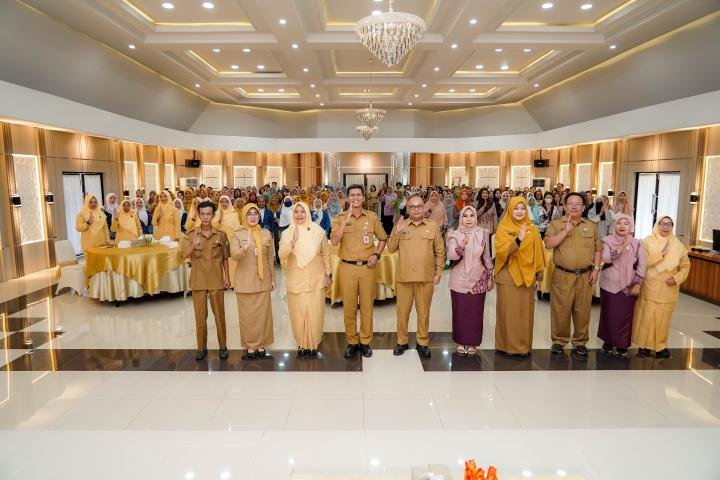
This commitment was demonstrated through a training program for early childhood educators held in Pontianak on Monday, November 9, 2026.
The training, themed “Strengthening the Competencies of Early Childhood Educators in Implementing the Nation’s Core Values to Achieve the Eight Dimensions of the Graduate Profile,” was organized by the West Kalimantan Provincial Government through the National Unity and Politics Agency (Kesbangpol), in collaboration with the West Kalimantan PAUD Ambassador (Bunda PAUD) and the Regional Board of the Association of Early Childhood Education Providers (DPD PP PAUD).

The event was officially opened on behalf of the Governor of West Kalimantan by Sefpri Kurniadi, Acting Assistant for Government and People’s Welfare at the West Kalimantan Provincial Secretariat.
Reading the Governor’s remarks, Sefpri emphasized the vital role of early childhood educators in shaping the character of future generations.
“The future of West Kalimantan is not somewhere far away in the clouds. It is reflected in the eyes of our children in early childhood classrooms,” Sefpri said, conveying the Governor’s message.
In his remarks, the Governor shared three key messages with educators.
First, educators were encouraged to become positive role models through their everyday attitudes and behavior, recognizing that young children learn more readily by imitating actions than by following verbal instructions.
Second, educators were urged to apply the knowledge gained during the training and guide children with compassion and empathy. They were also encouraged to minimize mobile phone use during classroom activities to ensure that children receive their full attention.
Third, educators were asked to instill a love for their country from an early age by introducing national symbols, including making the Indonesian national flag, the Red and White, a familiar presence in early childhood education environments.
The Governor also encouraged educators to introduce environmentally responsible habits, such as sorting waste, disposing of rubbish properly, gardening, and exploring nature through outdoor activities.
Building Character During the Golden Years of Childhood
In the organizing committee’s report, Brilianti Kesuma emphasized that introducing Pancasila values and national awareness should begin during early childhood, particularly during the critical period of development often referred to as the golden age.
“Early childhood educators are at the forefront of shaping the character of the nation’s future generations. They therefore need the understanding and skills to translate our nation’s core values into creative, enjoyable learning methods that are appropriate for children’s developmental stages,” she explained.
The training aimed to equip educators with practical knowledge, strategies, and skills to integrate national values into classroom learning and everyday routines.
It was also expected to strengthen educators’ professionalism and support the delivery of high-quality early childhood education services.
A total of 200 early childhood educators from Pontianak City and Kubu Raya Regency participated in the program.
The training featured three speakers: Mohammad Bari, S.Sos., M.Si., Head of the West Kalimantan National Unity and Politics Agency; Vivi Nurvijah, S.Pd., M.Pd., Chairperson of the West Kalimantan PAUD Ambassador Working Group; and Darmayeti, S.Pd., Secretary of the West Kalimantan Regional Board of the Association of Early Childhood Education Providers.
Education Beyond Academic Achievement
Meanwhile, Darmayeti, representing Windi Priastari, S.STP., M.Si., Chairperson of DPD PP PAUD West Kalimantan, emphasized that early childhood education should not focus solely on academic abilities.
She explained that education at this stage must also nurture children’s character, moral development, and understanding of religious, social, and cultural values.
“The success of early childhood education is determined not only by the curriculum or educational facilities, but also by the sincerity, positive example, and commitment of educators in supporting every stage of a child’s growth and development. Let us become educators who do more than teach—let us also inspire,” Darmayeti said.
During the training, participants received three main learning sessions covering the strengthening of Pancasila ideology, national awareness, and civic responsibility from an early age; the strategic role of PAUD Ambassadors in nurturing children with strong character through the eight dimensions of the graduate profile; and strategies for implementing these eight dimensions through learning activities grounded in religious, social, and cultural values, as well as educational field trips.
Through this initiative, the West Kalimantan Provincial Government and DPD PP PAUD hope that educators will apply their newly acquired knowledge and skills in their respective educational institutions.
These efforts are expected to improve the quality of early childhood education while nurturing a generation of West Kalimantan children who are intelligent, independent, morally grounded, nationally aware, and deeply committed to the Unitary State of the Republic of Indonesia.
Source: Kalbar Prov
About the Author
