


For the first time, West Kalimantan Province has been nominated for the 2026 Innovative Government Award (IGA), organized by Indonesia’s Ministry of Home Affairs. West Kalimantan is among 57 regional governments nominated for the award, which recognizes innovation in local governance.
With Indonesia comprising 514 regencies and cities and 38 provinces, West Kalimantan’s inclusion in the 2026 IGA nominations marks a significant milestone in its efforts to advance regional innovation, particularly in improving public services and addressing challenges faced by local communities.
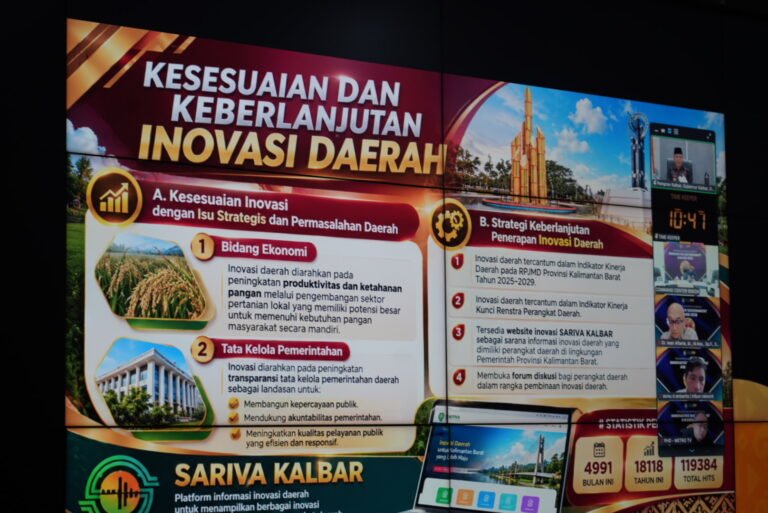
As part of the assessment process, West Kalimantan Governor Ria Norsan presented the province’s progress and achievements in regional innovation during an online session from the Data Analytic Room (DAR) at the West Kalimantan Governor’s Office on Thursday, November 5, 2026.
The presentation was evaluated by a panel of judges representing the Ministry of Home Affairs, the Ministry of National Development Planning (Bappenas), academics from Lambung Mangkurat University, Metro TV, and Tribunnews.
West Kalimantan’s nomination reflects the provincial government’s efforts to develop more innovative and communicative governance. Effective government leadership involves not only the ability to formulate policies but also the capacity to introduce innovations and communicate them effectively, ensuring that government programs are understood by the public, encourage participation, and deliver meaningful benefits.
These two elements are essential to strengthening the three primary functions of government: public service delivery, development, and community empowerment.
The public service function focuses on improving service quality and accessibility. The development function seeks to address regional challenges and improve community welfare. Meanwhile, community empowerment involves strengthening local capacities, expanding opportunities for participation, and encouraging public involvement in development processes.
Governor Ria Norsan emphasized that West Kalimantan’s nomination for IGA 2026 was both an achievement and a source of motivation to further strengthen a culture of innovation within government institutions.
“West Kalimantan’s nomination for IGA 2026 is an achievement and a motivation for us to continue strengthening a culture of innovation within government. However, what matters most is not simply receiving an award, but ensuring that the innovations we develop can respond to people’s needs, address regional challenges, and improve the quality of public services,” he stressed.

West Kalimantan Records 76 Regional Innovations in 2026
According to 2026 data, West Kalimantan has recorded 76 regional innovations. Of these, 67 innovations, or 88.16 percent, have reached the implementation stage, while six innovations, or 7.89 percent, remain at the initiative stage. Another three innovations, or 3.95 percent, are undergoing trials.
By category, digital innovations account for 53.95 percent of the total, while non-digital innovations represent 46.05 percent.
Two flagship innovations presented during the IGA 2026 assessment were GERAI-KU and SIDEKAP. Both were developed to address community needs in the food supply and healthcare sectors.
GERAI-KU: Connecting Farmers Directly with Consumers
GERAI-KU was developed to expand public access to essential food commodities, particularly eggs and chicken meat, through a marketing mechanism that directly connects poultry farmers and producers with consumers.
The initiative aims to shorten distribution chains, provide greater price certainty for farmers, and make food products more affordable for the public.
In addition to supporting inflation control and food supply stability, GERAI-KU serves as a platform for developing livestock-related micro, small, and medium enterprises (MSMEs) and supporting affordable food market programs.
GERAI-KU’s development has been supported by collaboration among various stakeholders, including Bank Indonesia, the Indonesian Air Force, provincial and regency/city government agencies, associations, cooperatives, businesses, community groups, and livestock farmers.
The innovation has also been replicated in Sintang and Ketapang regencies to extend its benefits to more communities.
SIDEKAP: Strengthening Patient Safety Through Integrated Digital Reporting
Meanwhile, SIDEKAP, the Integrated Incident Reporting System (Sistem Pelaporan Insiden Terintegrasi), was developed to improve patient safety and healthcare service quality.
SIDEKAP addresses limitations in the previous patient safety incident reporting process, which relied heavily on manual, paper-based documentation.
Through this digital system, incident reporting, verification, analysis, and follow-up can be managed in a more integrated and well-documented manner.
The system follows three core principles: No Name, No Shame, and No Blame.
These principles encourage healthcare workers to report incidents without fear of having their identities exposed, experiencing stigma, or being subjected to blame. As a result, incident reporting is intended to support organizational learning and continuous improvements in healthcare services.
SIDEKAP includes several features, such as online incident reporting, incident verification and assessment, Root Cause Analysis (RCA), recommendations for corrective action, monitoring, and a real-time reporting dashboard.
Implementation data show a steady increase in incident reports submitted through SIDEKAP.
The number of reports rose from 89 in 2024 to 204 in 2025, reaching 392 during the first six months of 2026 alone.
The increase is viewed as part of efforts to foster a stronger patient safety culture, encourage healthcare workers to report incidents openly, and improve risk management within healthcare facilities.
Innovation and Communication as Foundations of Effective Governance
Governor Ria Norsan reiterated that innovation and communication are two essential elements of government leadership.
Innovation must generate practical solutions, while effective communication ensures that government policies and programs are understood by the public and encourage meaningful community participation.
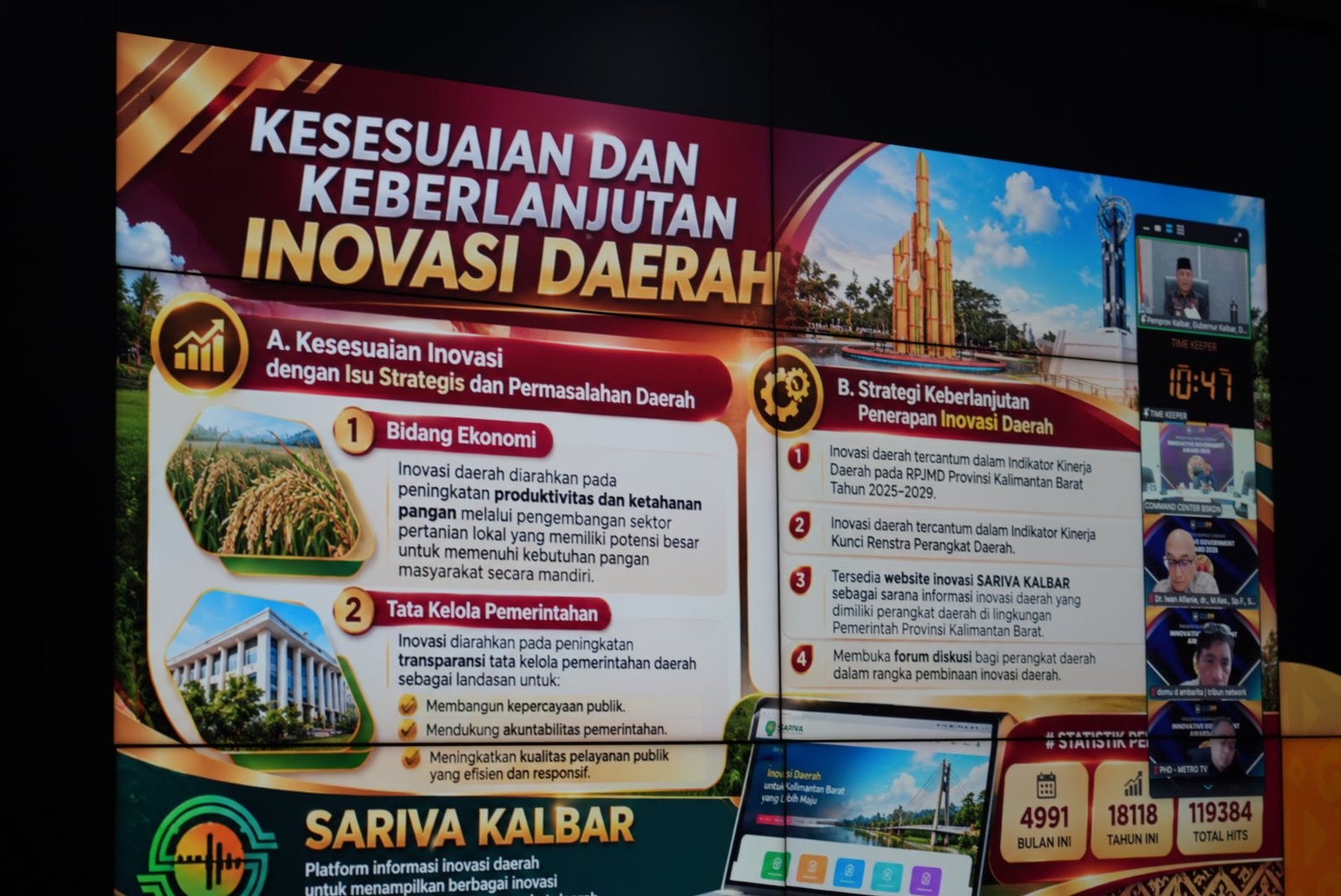
The sustainability of regional innovation is also being strengthened by incorporating innovation-related targets into the performance indicators of West Kalimantan’s 2025–2029 Regional Medium-Term Development Plan (RPJMD) and the key performance indicators of provincial government agencies.
In addition, the provincial government has developed the SARIVA KALBAR website as an information platform showcasing innovations introduced by regional government agencies. Discussion forums have also been established to support the development, mentoring, and improvement of these initiatives.
The Governor expressed hope that all regional government agencies would continue developing sustainable innovations with measurable impacts and the potential to be replicated across other areas.
“We want to ensure that innovation does not stop at the creation or assessment stage, but continues to be developed, implemented, and replicated so that its benefits can reach more people. This requires collaboration among all government agencies and stakeholders to build a government that is adaptive, solution-oriented, and increasingly connected to the communities it serves,” he concluded.
Through these initiatives, the West Kalimantan Provincial Government remains committed to strengthening governance, improving public service quality, accelerating regional development, and promoting community empowerment to improve the well-being of people throughout West Kalimantan.
Sumber: Kalbar Prov
About the Author
